


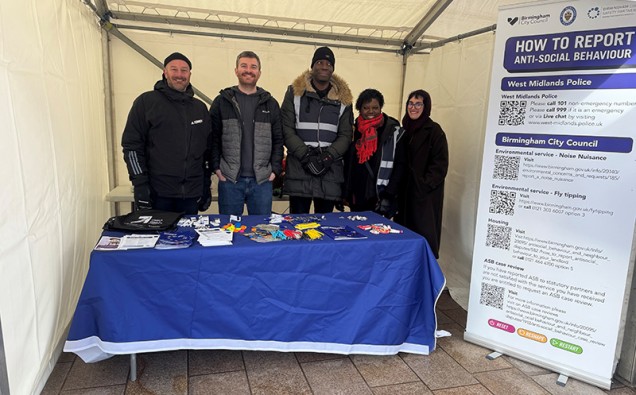
Birmingham City Councils Community Safety Team, in collaboration with a wide range of statutory and voluntary partners, expanded its Hyper Local Knife Crime Project during February half term.
Intensified early intervention efforts within city centre HEX hotspots, formed part of the Home Office funded national HEX programme focused on high risk, data identified areas and saw interactions with more than 500 people.
Partners involved included: Birmingham City Council, Birmingham Community Safety Partnership, West Midlands Police (WMP), West Midlands Violence Reduction Partnership (VRP), West Midlands Fire Service, West Midlands Air Ambulance, Guiding Young Minds (Youth Bus), Birmingham Youth Service, E R Mason, Purple Diamond, Aquarius, BCC Public Participation Team, Crimestoppers, Public Health, Community Foundation, and Positive Impact Development (PID), all working collectively to create safe spaces, deliver outreach and reduce harm.
This expanded activity built planned safety interventions across the city centre, which include increased knife bins and bleed kits, improved lighting, enhanced CCTV, detached youth workers out and about. The activity also saw a partnership response within the night time economy, the creation of Safe Spaces, the introduction of the Walk Safe app and many more interventions to increase safety and reduce knife crime in the city centre.
A collective partner-led diversionary programme
During the half-term, partners jointly delivered a coordinated programme of visible outreach, safe space provision and diversionary activity across the Birmingham city centre HEX zones, which included:
- Regular street based sport and recreation popups, including portable football, basketball and other multisport equipment, creating safe, supervised points of engagement for young people.
- A Chill Zone tent offering a protected social environment with music, seating and informal recreation to reduce exposure to unsafe locations.
- Daily engagement from trusted adults, youth workers, mentors and outreach teams offering advice, information, emotional support and pathways into longer term provision.
- Supported transitions into fixed youth spaces such as Community Foundation and Positive Impact Development gym, where young people accessed 1‑1 mentoring, employment guidance, CV support and additional activities.
- Chaperoned group activities, including visits to local sports venues and food establishments, enabling safer mentoring conversations and positive relationship building
- Engagement with schools and colleges across the city centre
- Continued engagement with young people already known to partners through previous outreach, allowing for consistency and sustained intervention.
Through this collaborative model, partners collectively maintained visible, youth led engagement across multiple HEX zones, ensuring continuity of support for young people most at risk of exploitation, harm or unsafe peer environments.
A coordinated approach to reducing harm
The combined efforts supported Birmingham’s wider city centre safety plan, which integrates prevention, engagement, education, enforcement and environmental improvements, including enhanced CCTV, improved street lighting and regular reassurance patrols.
This approach aligned with national guidance emphasising evidence based early intervention as essential for reducing knife crime and creating safer public environments. Regional analysis had previously highlighted significant challenges in Birmingham, including rising knife possession and the long-term effects of youth service reductions. These concerns were further illustrated through local HEX zone monitoring data: when the project began in October, there had been six reported knife crime incidents, followed by four reports in November, one in December, and one in January. This trend underscored both the ongoing risks and the critical importance of the visible, coordinated activity delivered over half term, helping partners to maintain a strong presence during a period where preventative action remained essential.
Councillor Jamie Scott, Cabinet Member for Social Justice, Community Safety and Equalities, said:
“This phase of the Hyper Local Knife Crime Project demonstrates the power of a united partnership approach.
“By bringing together statutory agencies, youth specialists and community based organisations, we created safe spaces, offered meaningful interventions and provided vital support to young people in the heart of our city.
“The collective effort of all of our partners who helped make this happen is key to making Birmingham safer for everyone.”